
For developers supervising Claude Code, Codex, and local coding agents
Keep coding agents inside
clear repo boundaries.
Voss gives local agent runs scoped tools, reusable project memory, approval gates, independent review, and an audit trail you can replay before you trust the result.
Bundles the Voss Python harness with vendored Python 3.12.
Six primitives, one org.
Voss models software work like a high-performing engineering organization — not a rigid automation pipeline. Every run is built from the same six primitives.
Capabilities
Every tool is a typed, permissioned, auditable capability. Network and shell are default-deny unless a role is granted them.
Principles
Engineering principles are first-class config in .voss, injected into every agent context and recorded in the audit.
Orchestration
An Engineering Manager loop turns one idea into scoped cards, assigns roles, partitions budget, and integrates the result.
Roles
architect, backend, frontend, tester, reviewer, skeptic, docs — declared in .voss team{} with their own scope, budget, and model tier.
Memory
VOSS.md, project memory, session trees, and decisions keep institutional context inspectable across runs.
Verification
Independent Reviewer-A and Reviewer-B gate completion. Agents cannot mark their own work done.
Engineering Manager loop
One idea in. Audited work out.
The Engineering Manager loop is the orchestrator: a constrained tech lead that decomposes, delegates, verifies, and integrates — and asks for you only when it matters.
Scope into cards
The EM converts one human idea into bounded work cards with acceptance criteria.
Assign roles
Each card is routed to a declared role from the team roster, with a recorded rationale.
Partition budget
Budget and scope fan out down the session tree. No child can overspend its parent.
Execute in parallel
Workers run concurrently inside their scope, within WIP limits, where it is safe to.
Verify continuously
Reviewer-A authors the verification bar from the original idea — not the EM's summary.
Review independently
Reviewer-B judges the diff narrative-blind and can fail idea-divergent work.
Block or integrate
Unverified or out-of-scope work is blocked with a reason. Clean work is integrated.
Audit and sign off
A replayable audit report is produced. Humans sign off only at meaningful moments.
The MVP flow
Declare a team. Run a goal.
A team is declared once in .voss: roles, scope, budget, and tools. Then a single goal runs as scoped, budgeted, independently reviewed work — with a replayable audit at the end.
$ voss team check
  team "default" ok — 7 roles, budget 120k, scope src/** tests/** docs/**

$ voss team run "Add password reset flow with tests"
  → 4 cards derived · assigned architect, backend, tester, docs
  → budget partitioned · 4 workers dispatched
  → reviewer-A authored 6 checks · reviewer-B verdict: pass (0.91)
  → run_id 7f3a9c · 1 card blocked (rescoped) · audit ready

$ voss review 7f3a9c
  per-card reviewer-A + reviewer-B verdicts · evidence refs · outcomes
Three workflows. One control layer.
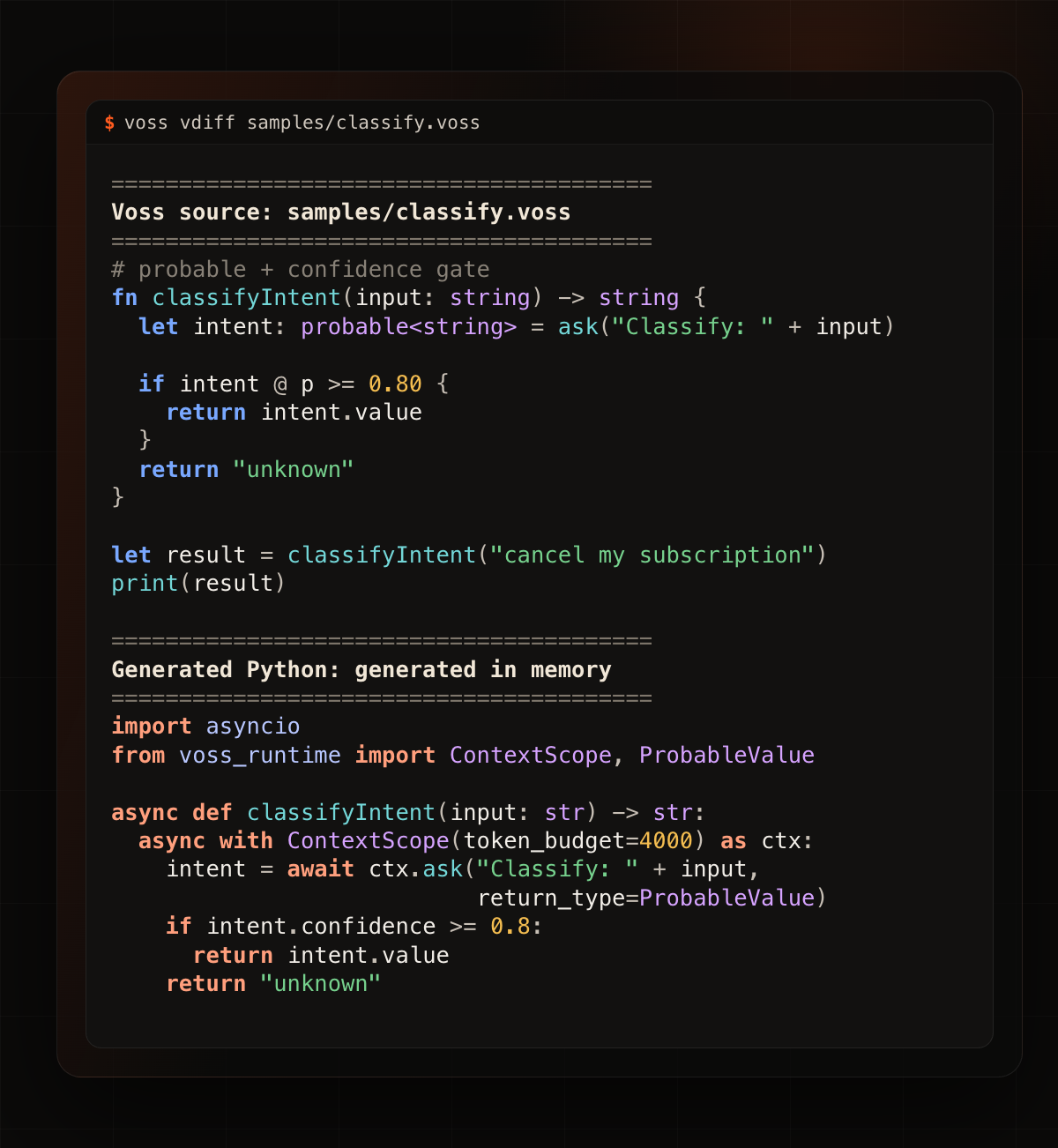
Run the canonical samples/ programs with voss run, or compare them with the raw Python equivalents in examples/raw_python/.
fn classifyIntent(input: string) -> string {
    let intent: probable<string> = ask("Classify the intent: " + input)

    if intent @ p >= 0.80 {
        return intent.value
    } else {
        return "unknown"
    }
}
The CLI.
One binary. Compiler verbs and agent verbs share a namespace, so you stay in flow whether you're shipping a program or asking it questions.
- $ voss team checkValidate roles, scope, budget, tools
- $ voss team run "add password reset"Run the goal as an engineering team
- $ voss boardWatch cards move across the board
- $ voss review <run_id>Inspect independent reviewer verdicts
- $ voss session tree <root_id>Per-agent budget, scope, status
- $ voss capabilities listInspect the agent toolbelt
- $ voss recall "permission gate"Search code and project memory
- $ voss do "summarize this PR"Single bounded agent task
- $ voss chatInteractive REPL with live subagents
- $ voss doctorDiagnose your environment
Install.
The npm package vendors Python 3.12 and the Voss wheel. Use pip when you manage Python 3.11+ yourself.
Audit
The audit is the trust product.
Every run produces a replayable trail: goal, principles, board, diffs, tests, reviewer verdicts, blocked work, and residual risk. EM claims are separated from verified evidence.
Declared in .voss.
Roles, scope, budget, tools, principles, and gates are a compiler-checked control language — not prompt soup. Static errors are clear enough for non-CS users.